
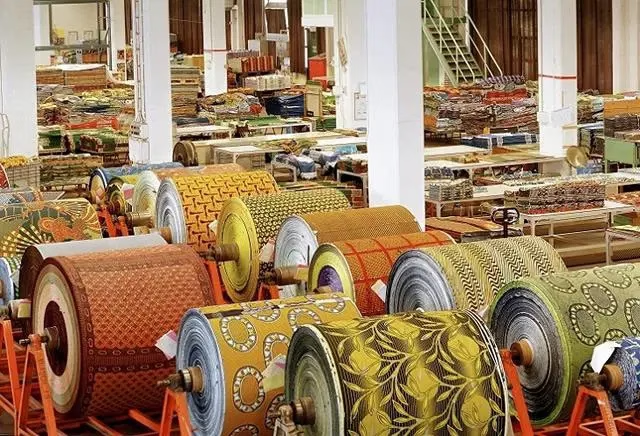
Textile Manufacturers Seek Stronger Trade Protection for Nigeria’s Local Industry
Nigeria’s textile industry is once again at the center of national economic discussions as local manufacturers intensify calls for stronger government intervention to protect domestic production from rising imports, smuggling and unfair foreign competition.
The Nigeria Textile Manufacturers Association (NTMA) has renewed its demand for more decisive trade policies aimed at reviving one of the country’s historically important industrial sectors. Industry leaders argue that without stronger protection measures and broader structural reforms, the textile sector will continue to struggle against cheaper imported products entering the market.
Speaking during a programme on the Nigerian Television Authority (NTA), the Director-General of NTMA, Dr. Hamma Ali Kwajaffa, stated that the association has consistently advocated for stricter trade regulations and stronger import control mechanisms rather than marginal tariff increases, which he believes have failed to provide meaningful support to local manufacturers.
According to Kwajaffa, the current market environment has placed local textile producers under enormous pressure, with excessive imports and widespread smuggling significantly reducing the competitiveness of Nigerian-made products.
The NTMA’s position reflects recent developments at the policy level. Nigeria’s Senate has reportedly encouraged the Federal Government to consider stronger measures, including imposing a total ban on textile imports, enforcing local content policies and expanding financial support through the Bank of Industry (BoI) to strengthen domestic manufacturing capacity.
Industry stakeholders believe that such measures could help stimulate investment, revive idle factories and create employment opportunities across the textile value chain.
Nigeria’s textile industry was once regarded as one of Africa’s largest employers outside the public sector, supporting thousands of workers across cotton farming, fabric manufacturing, garment production and distribution networks. However, decades of market challenges, rising production costs and dependence on imported products have weakened the sector considerably.
Kwajaffa noted that the impact of unchecked importation and dumping practices has led to the closure of numerous textile mills and resulted in significant job losses across the country.
He emphasised that policy interventions must go beyond import restrictions and include comprehensive industry development strategies. According to him, border enforcement and effective implementation of trade regulations remain essential to controlling the flow of low-cost imported fabrics that continue to undermine local businesses.
At the same time, he acknowledged that trade protection alone cannot solve all industry challenges.
One of the major concerns highlighted by NTMA is the declining availability of raw materials. The collapse of local cotton production has created supply shortages for textile manufacturers, forcing many companies to rely on imported inputs.
Kwajaffa stressed that rebuilding Nigeria’s cotton value chain should become a national priority. He called for stronger government incentives for cotton cultivation, improved agricultural extension services and direct support for farmers to boost productivity and ensure a stable supply of raw materials for textile mills.
Another major issue facing manufacturers is the difficulty in accessing affordable locally produced polyester, an important input for modern textile production.
Energy costs also remain a serious burden for the industry. Despite Nigeria’s position as a major crude oil producer, many manufacturers continue to face high operating expenses due to energy shortages and expensive power alternatives, which increase overall production costs and reduce competitiveness.
Security challenges in farming communities were also identified as a critical obstacle. According to NTMA, insecurity has limited the ability of extension workers and agricultural support agencies to engage effectively with farmers, contributing to lower cotton yields and weaker supply chains.
Industry observers suggest that a successful revival of Nigeria’s textile sector will require a balanced approach that combines trade protection, industrial investment, agricultural development, improved infrastructure and stronger enforcement mechanisms.
As Nigeria continues to pursue economic diversification and industrial growth, the textile sector remains a strategic area with significant potential to generate employment, strengthen local manufacturing and reduce dependence on imports.
