
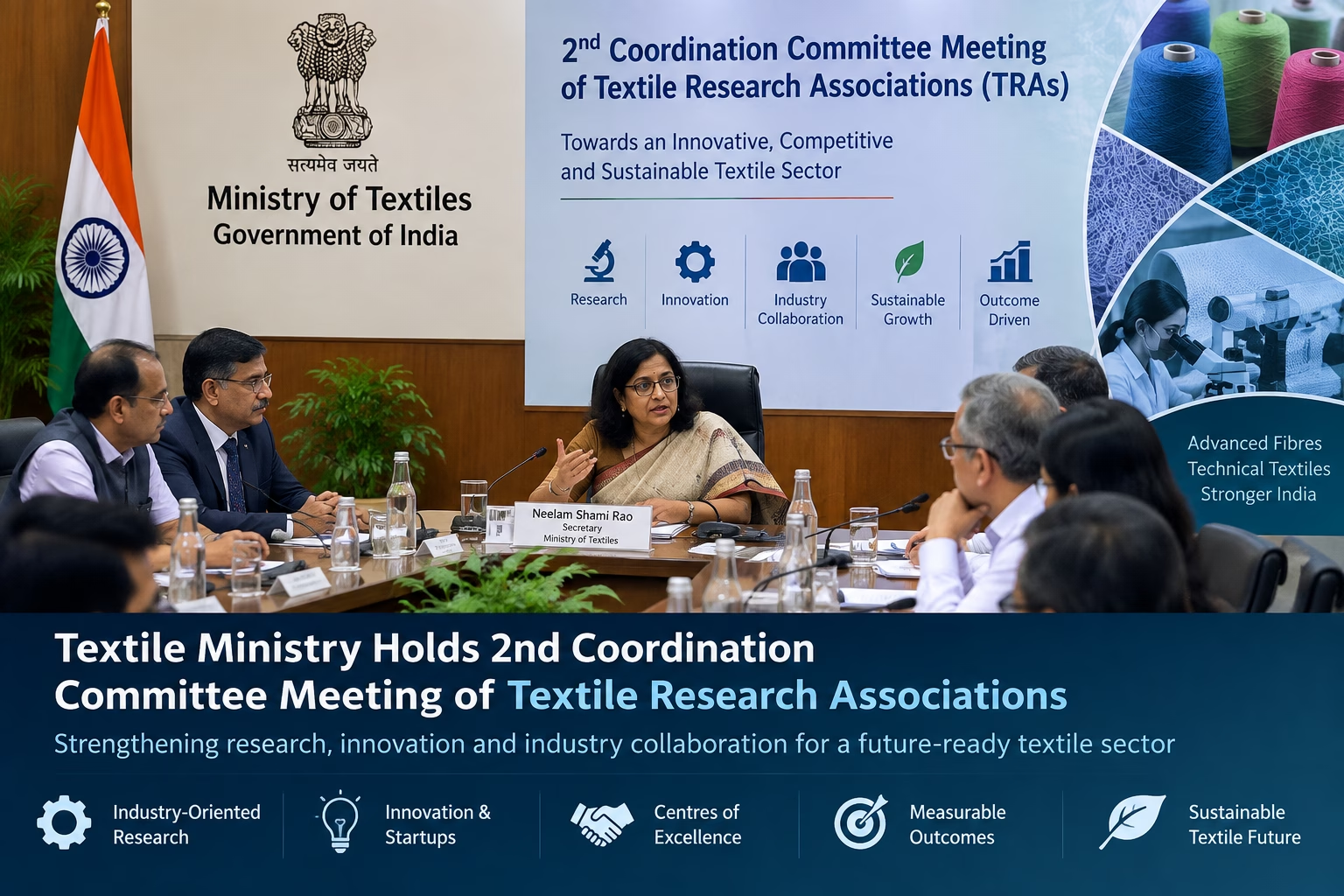
Textile Ministry Strengthens Industry-Oriented Research Through 2nd TRA Coordination Committee Meeting
New Delhi, August 31, 2026: The Ministry of Textiles has held the second Coordination Committee Meeting of Textile Research Associations (TRAs) in New Delhi, reinforcing its focus on making textile research more collaborative, industry-oriented and outcome-driven.
The meeting was chaired by Neelam Shami Rao, Secretary, Ministry of Textiles, and brought together senior officials from the Ministry, leading Textile Research Associations, the Office of the Principal Scientific Adviser, the Department of Science & Technology (DST), CSIR institutions and Indian Institutes of Technology (IITs).
The meeting reviewed the progress made since the first Coordination Committee Meeting and discussed strategies to strengthen India’s textile research and innovation ecosystem.
Focus on Stronger Research Infrastructure
One of the key developments reviewed during the meeting was the strengthening of equipment inventory and digital information systems through the Integrated Textile Research and Application Management System (i-TRAMS) portal.
The platform is expected to play an increasingly important role in monitoring research activities, mapping institutional capabilities and connecting industry requirements with available research infrastructure.
The committee also reviewed the formation of specialised sub-committees, identification of Centres of Excellence and initiatives related to New Age Fibres. Emerging opportunities in technical textiles also remained a major area of discussion.
India’s textile industry is rapidly expanding beyond conventional apparel and fabrics into high-performance applications such as automotive textiles, geotextiles, medical textiles, protective materials and sustainable advanced fibres. Strengthening research institutions is therefore considered critical for supporting the next phase of industry growth.
Global Benchmarking and Technology Commercialisation
A major focus of the discussions was improving the global competitiveness of India’s Centres of Excellence.
Participants discussed the need for global benchmarking to ensure that Indian textile research institutions operate at internationally competitive standards. The adoption of a Technology Readiness Assessment Framework was also discussed to help evaluate the maturity of new technologies and improve their journey from laboratory research to commercial applications.
The Ministry emphasised that research should not remain limited to academic studies or laboratory-level developments.
Instead, Textile Research Associations have been encouraged to focus on measurable and commercially relevant outcomes such as:
- Development of new technologies
- Filing of patents
- Creation of functional prototypes
- Technology commercialisation
- Import substitution
- Solutions for MSMEs
- Industry-led innovation
The emphasis reflects a growing shift in India’s research ecosystem towards translating scientific knowledge into market-ready technologies.
Industry Participation to Play a Bigger Role
The Coordination Committee strongly emphasised the importance of involving industry at the early stages of research conceptualisation.
Traditionally, research institutions often develop technologies independently before searching for industrial applications. The Ministry is encouraging a reverse approach where industry challenges and market requirements help define research priorities.
This approach could help Textile Research Associations develop solutions that directly address challenges faced by manufacturers, exporters and small and medium enterprises.
Greater industry involvement is also expected to improve the commercial adoption of research outcomes and reduce the gap between laboratories and factories.
Support for Startups and Innovation
The meeting also discussed expanding support for startups and innovation within the textile sector.
India’s textile ecosystem is witnessing increasing interest in areas such as sustainable fibres, textile recycling, smart textiles, technical textiles, automation, digital manufacturing and advanced materials.
Strengthening collaboration between TRAs, startups, academic institutions and industry could accelerate the development of commercially viable technologies.
The proposal for a common e-library platform was also discussed, which could improve access to research resources, technical information and knowledge-sharing among institutions.
National Technical Textiles Mission Projects Reviewed
The implementation of projects under the National Technical Textiles Mission (NTTM) was another important agenda item.
Technical textiles have been identified as a strategic growth area for India, with applications across infrastructure, healthcare, defence, agriculture, transportation and environmental protection.
The meeting explored ways to improve project implementation, enhance external funding opportunities and strengthen collaboration among research institutions.
Officials also reviewed the importance of attracting funding beyond government-supported programmes to create a stronger and more sustainable research ecosystem.
Planning for 2026-27
The Coordination Committee also discussed the Five-Year Plans and Annual Action Plans for the financial year 2026-27.
Other important areas included skill development, governance reforms, membership growth and the introduction of KPI-based performance evaluation for Textile Research Associations.
The use of Key Performance Indicators is expected to bring greater accountability and transparency to research organisations. Institutions may increasingly be evaluated based on the practical impact of their work rather than only the number of research projects undertaken.
Building a Future-Ready Textile Research Ecosystem
The second Coordination Committee Meeting signals a clear direction for India’s textile research ecosystem.
The Ministry of Textiles is seeking to build stronger connections between research institutions, industry, startups and academic organisations. The focus is gradually shifting towards technologies that can solve real industrial challenges and create measurable economic value.
With increasing global competition and rapidly changing textile technologies, India will need stronger capabilities in innovation, advanced materials and technical textiles.
The effective use of platforms such as i-TRAMS, combined with industry participation and performance-based evaluation, could help Textile Research Associations play a more strategic role in the future of the Indian textile industry.
The Ministry’s latest initiative highlights an important message: the future of textile research will not only be measured by scientific discoveries, but by how successfully those discoveries are transformed into technologies, businesses and industrial solutions.
