
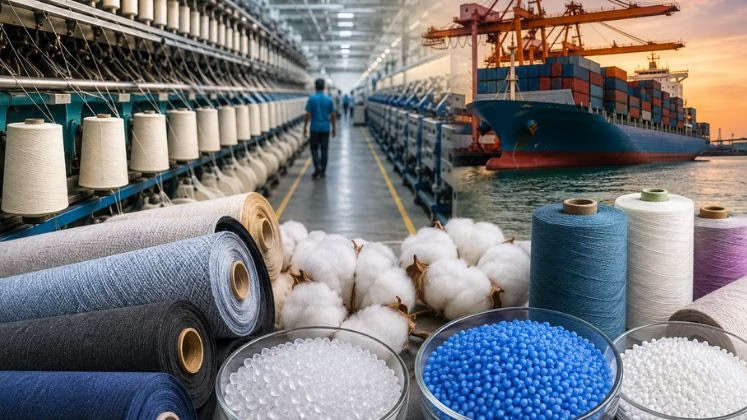
NITI Aayog Urges India to Accelerate MMF Shift to Achieve $100 Billion Textile Export Target
New Delhi: India must make a strategic shift towards man-made fibre (MMF)-based products, larger-scale manufacturing, technology upgrades and stronger global market access to achieve its ambitious US$100 billion textile export target by FY30, according to a new report by NITI Aayog, prepared in collaboration with CRISIL Intelligence.
Textiles has been identified among the 12 manufacturing sectors with the potential to help India emerge as a global manufacturing leader. The sector contributes around 2% to India’s GDP, 11% of manufacturing GVA and 9% of merchandise exports, while providing livelihoods to more than 45 million people.
India exported approximately US$37.7 billion worth of textile products in FY25, accounting for around 4.1% of global textile and apparel exports and ranking sixth globally. Nearly 80% of the country’s textile capacity is concentrated in MSME clusters.
Global Demand Shifting Towards MMF
The global textile industry is projected to reach around US$1.78–1.83 trillion by 2027, expanding at a CAGR of 2.5–3.5% between 2023 and 2027. Fast fashion, e-commerce, urbanisation and rising disposable incomes are expected to remain key growth drivers.
NITI Aayog highlighted the increasing importance of synthetic fibres in this expansion. Between 2018 and 2023, natural fibres represented around 44% of the global textile market by value, while polyester accounted for 29% and nylon 20%.
Demand for durable, wrinkle-resistant, quick-drying and performance-oriented products is expected to further increase consumption of MMF-based textiles.
Global textile trade stood at approximately US$901 billion in 2023, with apparel representing the largest segment, followed by fabrics and home textiles. Asia-Pacific remains the dominant supplier, led by China, India, Bangladesh and Vietnam, while the US and Europe continue to be major consumption markets.
India’s Cotton Dependence a Growing Challenge
India has capabilities across almost the entire textile value chain, including cotton, MMF, yarn, fabrics, garments, home textiles and technical textiles. The country accounted for around 22% of global cotton production in the 2023/24 marketing year and remained the world’s largest exporter of cotton yarn, with a 29% share of global cotton yarn exports in CY2023.
However, the report warned that India’s heavy dependence on cotton could become a constraint as global demand increasingly moves towards synthetic fibres.
Cotton yarn production declined at an annual rate of around 5%, from 3,962 million kg in FY20 to 3,438 million kg in FY23. In contrast, production of man-made filament yarn and blended/non-cotton yarn increased to around 3,650 million kg.
The domestic ready-made garment sector is estimated to grow at around 5% CAGR between FY23 and FY30, while exports could expand at approximately 6%. Meanwhile, India’s domestic MMF market, valued at about US$6.8 billion, is projected to grow at 6–7% CAGR during the period.
Feedstock Costs Remain a Major Concern
Despite strong growth potential, India’s MMF industry faces significant competitiveness challenges, particularly in the availability and cost of raw materials.
Polyester and viscose together account for around 97% of India’s fibre consumption. Polyester manufacturing depends heavily on purified terephthalic acid (PTA) and monoethylene glycol (MEG). India currently meets only about 75% of PTA demand and 65% of MEG demand through domestic production, with the remainder being imported.
According to the report, import dependence, crude oil price volatility, currency fluctuations and limited domestic feedstock capacity increase costs for Indian polyester manufacturers. Indian MMF companies also face weaker financial performance than several international peers because of higher raw-material costs, low capacity utilisation, limited economies of scale and insufficient technology upgrades.
NITI Aayog Recommends GST and Duty Reforms
To improve the competitiveness of India’s MMF industry, NITI Aayog has recommended reducing the GST burden on PTA and MEG to address the inverted duty structure.
GST on polyester fibre, yarn and fabric was reduced to 5% in September 2025, but PTA and MEG continue to attract 18% GST. The report said this creates working-capital blockages for yarn and filament manufacturers.
The report has also recommended reducing or eliminating the 5% customs duty on MEG, as approximately 35% of India’s MEG requirement is currently met through imports.
Capacity Expansion Could Improve Self-Sufficiency
India is expected to add approximately 5.5 million tonnes per annum of PTA capacity over the next two to three years. This expansion could significantly reduce import dependence and move the country closer to self-sufficiency in a critical polyester feedstock.
The report’s recommendations underline the need for India to move beyond its traditional cotton-centric textile strategy and build a more diversified, technology-driven and globally competitive textile industry.
With global MMF demand rising, stronger domestic feedstock availability, investment in modern manufacturing and supportive tax policies could help India capture a larger share of the international textile and apparel market and move closer to its US$100 billion export ambition by FY30.
