
Pakistan Can Import Textile Waste from Bangladesh: Says BGMEA President
Dhaka, June 29, 2025 (BSS) – Pakistan can now look to Bangladesh for fulfilling the growing needs of its textile recycling industry. According to Mahmud Hasan Khan Babu, President of the Bangladesh Garment Manufacturers and Exporters Association (BGMEA), Bangladesh is ready to export textile waste to Pakistan. This move could help both countries grow economically and strengthen their trade ties.
Growing Interest from Pakistan
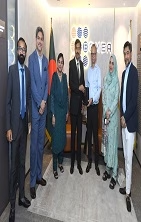
The announcement came during a special visit by Muhammad Wasif, Chargé d’Affaires of the Pakistan High Commission in Bangladesh. He visited the BGMEA office in Uttara, Dhaka, where the two sides discussed future trade and investment possibilities.
Wasif was accompanied by Zain Aziz, the Trade and Investment Attaché of the High Commission. On the BGMEA side, Vice-President Md Rezwan Selim and Directors Faisal Samad, Sumaiya Islam, and Fahima Akhter joined the meeting.
Why Textile Waste?
Bangladesh is a global leader in garment manufacturing. Every year, thousands of tons of fabric waste are produced during the making of clothes. This waste, often called “textile waste” or “pre-consumer waste,” includes leftover fabric, rejected clothes, and other garment scraps. While some of this is reused locally, a large portion is still available for recycling.
Pakistan has a growing textile recycling industry. These industries take fabric waste and turn it into yarn or other usable materials. For Pakistan, importing such waste is a cost-effective and environment-friendly solution.
“Pakistan’s recycling industry can benefit from Bangladesh’s garment waste. We can create a win-win situation by setting up a proper trade system,” said BGMEA President Babu.
Importance of Jute Fibre
Apart from garment waste, jute fibre was another major topic of discussion. Bangladesh is the largest producer of jute in the world. This natural fibre is used for making bags, carpets, ropes, and many eco-friendly products.
The BGMEA President noted that Pakistan has strong demand for jute fibre, and importing it from Bangladesh could help meet that demand.
“If Pakistan imports jute fibre, it will be beneficial for both countries,” said Babu.
Strengthening Trade Ties
During the meeting, both sides discussed how they could further improve trade relations, especially in the garment and textile sectors.
Bangladesh is known for its ready-made garments (RMG). It exports billions of dollars’ worth of clothes to Europe, the USA, and other regions every year. Recently, the country has also made strong progress in producing garment accessories like buttons, zippers, labels, and packaging materials.
On the other hand, Pakistan has a strong textile base with quality cotton, yarn, and fabrics that Bangladesh can import for its garment factories.
Discussions also focused on:
- Increasing textile imports from Pakistan
- Exporting ready-made garments and accessories from Bangladesh to Pakistan
- Organizing business delegations and trade exhibitions
- Conducting joint workshops for industry knowledge sharing
Reviving a Past Agreement
A Memorandum of Understanding (MoU) was already signed earlier between BGMEA and PRGMEA (Pakistan Readymade Garments Manufacturers and Exporters Association). This MoU aimed to promote bilateral trade and cooperation in the textile sector.
However, both parties felt that more active involvement from the business community is needed to bring this MoU to life. During the meeting, they agreed to appoint “focal points” — individuals or teams in both countries — to ensure that the MoU leads to practical results.
Why This Matters
Trade between Pakistan and Bangladesh has been slow in recent years, largely due to political issues and lack of strong trade mechanisms. However, the textile and garment sector offers a unique opportunity for both countries to grow together.
Bangladesh has the production capacity and raw materials like jute and garment waste. Pakistan has the infrastructure and technology for recycling and a large market for these materials.
By working together, both countries can:
- Create jobs
- Reduce environmental pollution by recycling waste
- Earn foreign currency
- Strengthen regional cooperation in South Asia
Future Steps
Both BGMEA and the Pakistani High Commission agreed on several action points:
- Share industry knowledge and market information
- Send trade delegations for exploring new opportunities
- Work together on textile fairs and exhibitions
- Support startups and young entrepreneurs in the textile recycling space
- Ensure smooth logistics and customs clearance between ports
Final Thoughts
The BGMEA President expressed hope that this new chapter in trade between Bangladesh and Pakistan would bring mutual benefits. He called on the governments, private businesses, and industry groups from both countries to work closely and make this vision a reality.
“Textile and garment industries are the lifelines of our economies. By helping each other, we can move toward a sustainable and prosperous future,” he concluded.
