
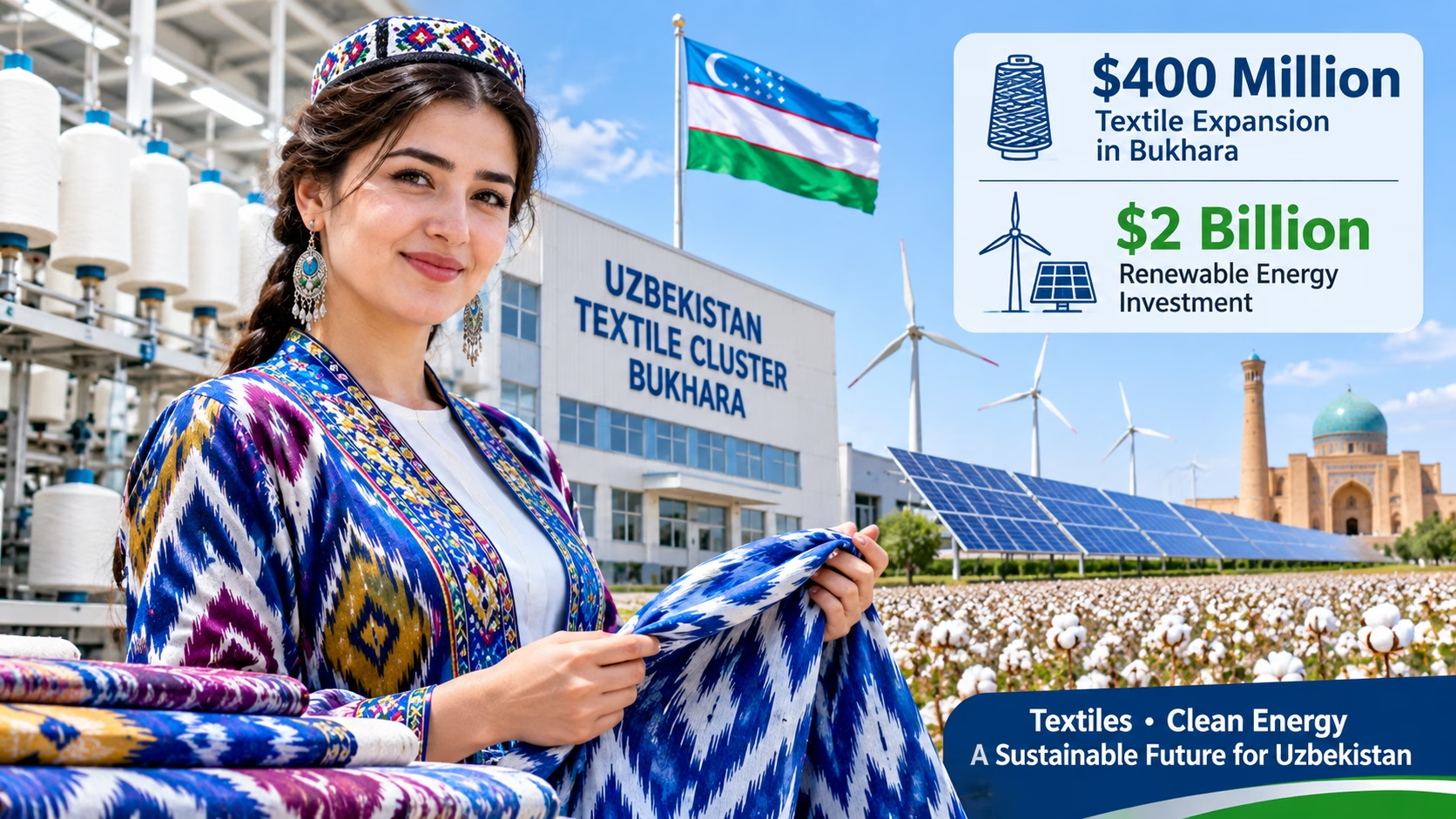
Uzbekistan Combines $400 Million Textile Expansion with $2 Billion Renewable Energy Investment in Bukhara
Uzbekistan is strengthening its textile manufacturing capabilities alongside major renewable energy investments, with a strategy aimed at increasing value-added production, boosting exports and supporting cleaner industrial growth.
Uzbekistan is moving ahead with a $400 million cotton-textile cluster in the Bukhara region as part of a broader industrial development strategy that links textile manufacturing with renewable energy infrastructure.
Chinese investors are developing the new cotton-textile cluster in the Romitan district. In addition, another textile complex under the Kurt Baver brand is planned in Bukhara city, with an annual production capacity of 62,000 tonnes.
The two developments are expected to increase the share of higher-value-added textile products to 65% and generate an additional $100 million in export revenue. The investments reflect Uzbekistan’s ambition to move beyond basic cotton processing towards more advanced textile manufacturing and finished products.
$2 Billion Investment in Renewable Energy
Alongside textile expansion, Bukhara has attracted approximately $2 billion in renewable energy investments in recent years.
The region has already commissioned 1,000 MW of wind power and 750 MW of solar power, supported by 63 MW of energy storage capacity.
Several additional renewable energy projects are also underway:
- ACWA Power: Developing a 300 MW wind power plant in Gijduvan district.
- Toyota Corporation and Sinoma: Constructing wind power facilities with a combined capacity of 1,000 MW in Jondor and Peshku districts.
- Waste-to-energy project: A proposed $165 million investment with Chinese partners to generate electricity from municipal waste in Kagan district.
These projects are expected to further strengthen the region’s electricity generation capacity and support its growing industrial requirements.
Textile Manufacturing and Clean Energy Go Hand in Hand
The development strategy highlights the increasing connection between textile manufacturing and renewable energy.
As global textile buyers place greater emphasis on sustainability, carbon emissions and responsible production, access to cleaner electricity is becoming an important factor in manufacturing competitiveness.
For Uzbekistan’s textile industry, renewable energy could help reduce dependence on conventional power sources, improve energy security and support manufacturers targeting international markets with stricter environmental requirements.
What This Means for the Textile Industry
The combination of textile manufacturing and renewable energy investment could strengthen Uzbekistan’s position in the global textile supply chain.
The focus on higher-value-added products, increased production capacity and export growth indicates a shift towards a more integrated textile industry.
The real measure of success will be how effectively these investments translate into higher-value textile production, increased export earnings, reliable energy access and stronger international competitiveness.
Uzbekistan’s approach offers an important example of how textile industrial development and renewable energy infrastructure can work together to shape the future of the global textile industry.
