
India may emerge as second-largest economy by 2038 with $34.2 trillion GDP
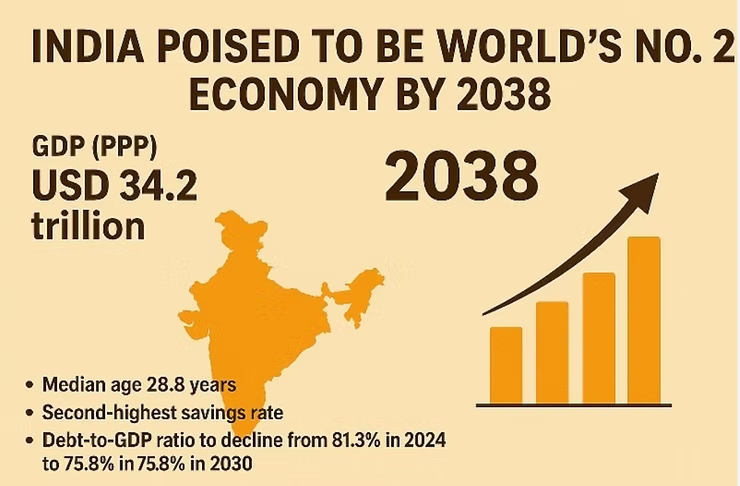
India could become the second-largest economy by 2038 with a GDP of $34.2 trillion (PPP), according to a report by EY.
New Delhi, 27 August 2025: India is showing strong growth potential among the world’s top five economies. This is because of high savings and investment rates, a young population, and a stable government budget. Even though there are global challenges like trade barriers and slower global trade, India is doing well because it depends more on its own market and is improving its tech skills.
Among the biggest economies, India has a unique position.
In 2025, the average age is 28.8 years, which is very young. India also has the second-highest savings rate, and its government debt compared to GDP is expected to drop from 81.3% in 2024 to 75.8% by 2030. Unlike others where debt is rising, India’s debt is coming down. According to the IMF, India’s economy could reach $20.7 trillion (PPP) by 2030. Using the average growth rates from 2028 to 2030 as predicted by the IMF, India could become the second-largest economy in terms of PPP by 2038, with a projected GDP of $34.2 trillion.
Compared to the US, China, Germany, and Japan, India has a strong position.
China is the biggest economy with a projected GDP of $42.2 trillion (PPP) by 2030, but it faces challenges like an aging population and rising debt. The US remains powerful but has very high debt and slower growth. Germany and Japan are advanced, but their populations are aging and they depend heavily on international trade. India, however, has a younger population, growing domestic demand, and a more stable financial outlook. These factors make India’s long-term growth potential look better.
DK Srivastava, Chief Policy Advisor at EY India, said, “India’s strengths, like a young and skilled workforce, high savings and investment, and a relatively low debt level, will help the country grow even in tough global conditions.
By building strength and advancing in key technologies, India is heading towards its vision of a developed nation by 2047.”
India’s future is also supported by structural changes and strong fundamentals.
High saving and investment rates are helping build more capital, while better budget management is making the economy more stable. Reforms like GST, IBC, UPI for financial inclusion, and production-linked incentives are making businesses more competitive. At the same time, government spending on infrastructure and using new technologies like AI, semiconductors, and renewable energy are helping prepare the country for long-term success.
India is also expected to become the third-largest economy by market exchange rates by 2028, surpassing Germany.
While US tariffs could affect nearly 0.9% of India’s GDP, their impact on growth can be kept to just 0.1 percentage point with steps like diversifying exports, building stronger domestic demand, and expanding trade partnerships.
